“She just needs to be more confident.”
It is one of the most common pieces of feedback women receive throughout their careers.
Often, it is delivered with good intentions.
A manager wants to help.
A leader believes they are offering constructive advice.
An organisation assumes it is identifying a development need.
But what if confidence is not actually the problem?
What if, in many cases, confidence has become a convenient explanation for something much deeper?
At Lead with Difference Global, we believe too many organisations are still viewing leadership potential through a narrow lens of what confidence looks like rather than what leadership capability actually is.
And when that happens, talented women are often overlooked, not because they lack leadership potential, but because they do not display it in the way organisations expect.
When Confidence Becomes a Catch-All Explanation
Consider two employees.
Both are highly capable.
Both consistently deliver strong results.
Both are respected by their colleagues.
One frequently speaks first in meetings, confidently shares opinions, and readily promotes their achievements.
The other listens carefully, contributes thoughtfully, and focuses more on impact than visibility.
Too often, the first employee is described as confident and leadership-ready.
The second may be described as needing to “build confidence”.
Yet there may be little difference in their actual capability.
The difference is often in how confidence is expressed—and how it is perceived.
This matters because many organisations unintentionally equate confidence with visibility.
And visibility is not always the same thing as leadership effectiveness.

The Problem Is Not Confidence—It Is How We Measure It
At Lead with Difference Global, we are not suggesting confidence is unimportant.
Leaders need confidence.
People need confidence in their decisions, their judgement, and their ability to guide others through uncertainty.
The challenge arises when confidence is defined too narrowly.
For example, confidence is often associated with:
- Speaking frequently
- Being highly assertive
- Promoting achievements openly
- Taking up space in discussions
- Appearing certain at all times
These behaviours can absolutely reflect confidence.
But they are not the only ways confidence shows up.
Confidence can also look like:
- Calm decision-making under pressure
- Thoughtful contributions that move conversations forward
- Quiet conviction in the face of challenge
- Consistent delivery of results
- The willingness to ask difficult questions
- Creating confidence in others
The problem is that many leadership frameworks recognise the first set of behaviours more readily than the second.
As a result, some talented women are judged against expectations that were never designed with diverse leadership styles in mind.
Why Women Often Receive Different Messages About Confidence
Women frequently navigate a difficult balancing act.
If they are highly assertive, they may be perceived as aggressive.
If they are collaborative, they may be viewed as lacking authority.
If they advocate strongly for themselves, they risk being judged differently from male colleagues exhibiting the same behaviours.
This creates what researchers often refer to as a double bind.
Women can find themselves receiving conflicting expectations:
- Be confident, but not too confident.
- Be ambitious, but remain approachable.
- Be authoritative, but stay likeable.
These mixed messages can make leadership progression more complex than organisations realise.
The issue is not a lack of confidence.
The issue is that confidence is often being assessed through inconsistent and subjective standards.

The Cost of Misreading Leadership Potential
When organisations rely too heavily on narrow indicators of confidence, they risk overlooking high-potential talent.
That has consequences for both individuals and businesses.
Employees who repeatedly receive vague feedback such as:
- “You need more presence.”
- “You need to speak up more.”
- “You need to be more confident.”
May begin to question their leadership potential.
Some withdraw from progression opportunities.
Others stop putting themselves forward.
Some eventually leave in search of environments where their contributions are recognised more fully.
And organisations lose more than people.
They lose:
- Future leaders
- Diverse perspectives
- Innovation
- Experience
- Return on development investment
The cost of overlooking talent is not always immediately visible.
But over time, it weakens leadership pipelines and limits organisational growth.
Moving Beyond Confidence as a Leadership Shortcut
At Lead with Difference Global, we believe organisations need to become more precise in how they assess leadership readiness.
Rather than asking:
“Does this person appear confident?”
Leaders should ask:
- Can they influence outcomes?
- Do they make sound decisions?
- Can they build trust?
- Do they navigate complexity effectively?
- Can they bring others with them?
These questions focus on capability rather than style.
And capability is a far stronger predictor of leadership success.
Four Questions Leaders Should Ask
1. How Are We Defining Confidence?
Are we measuring genuine leadership capability, or are we rewarding a specific communication style?
2. What Feedback Are Women Receiving?
Is feedback focused on measurable behaviours and outcomes, or vague concepts such as “presence” and “confidence”?
3. Which Leadership Styles Are Being Rewarded?
Do progression pathways accommodate different ways of leading, influencing, and communicating?
4. Who Are We Overlooking?
Which high-performing individuals may be delivering exceptional value but receiving less recognition because they do not fit traditional leadership expectations?
A Final Reflection
Confidence matters.
But leadership is bigger than confidence.
And confidence itself comes in many forms.
At Lead with Difference Global, we believe organisations need to move beyond outdated assumptions about what leadership looks like and start recognising the diverse ways leadership capability is expressed.
Because when confidence is viewed through a narrow lens, organisations risk overlooking some of their most capable future leaders.
The question is not whether women are confident enough to lead.
The question is whether organisations are broadening their understanding of what confident leadership actually looks like.
Because leadership readiness should be measured by impact, not by how closely someone resembles the leaders who came before them.
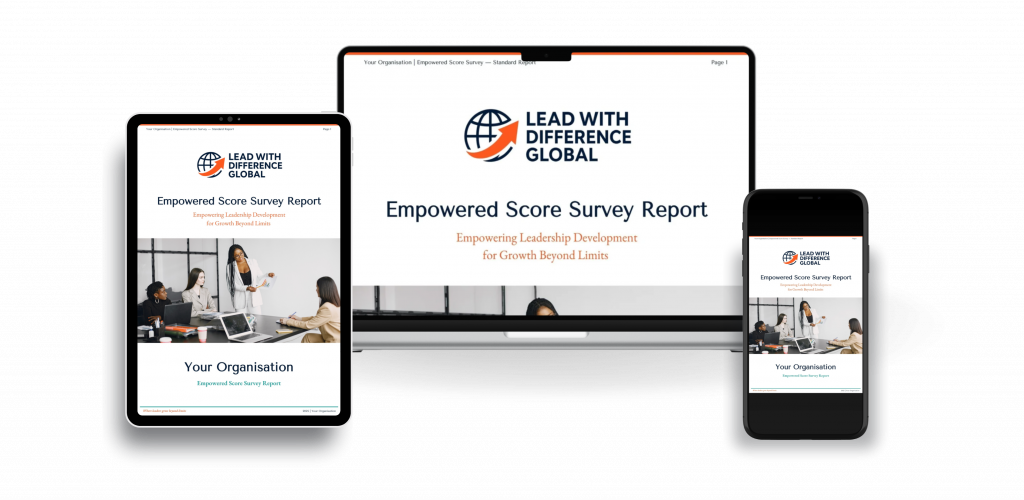
Are You Ready to Understand How Empowered Your People Feel to Progress?
Take Lead with Difference Global’s Empowered Score Survey (ESS) to better understand the experiences shaping wellbeing, engagement, progression, and retention across your workforce.
Because when people feel empowered to lead authentically, they do not just develop confidence.
They develop the influence, impact, and leadership capability organisations need for the future.
Leave a Reply